Legal Document Automation and Legal Efficiency sets the stage for this enthralling narrative, offering readers a glimpse into a story that is rich in detail and brimming with originality. Technology has revolutionized legal efficiency, paving the way for automated legal document processes.
Let's delve into the world of legal automation and explore its impact on streamlining legal workflows.
Legal Document Automation
Legal document automation refers to the use of technology to streamline and simplify the process of creating, managing, and storing legal documents. By automating repetitive tasks and standardizing document creation, legal professionals can save time, reduce errors, and increase overall efficiency.
Examples of Commonly Automated Legal Documents
- Contracts: Standardized clauses and templates can be used to quickly generate contracts tailored to specific needs.
- Non-Disclosure Agreements (NDAs): Automated tools can populate NDA forms with relevant information, saving time and ensuring accuracy.
- Leases: Landlords and tenants can use automated systems to generate lease agreements with customized terms and conditions.
Benefits of Automating Legal Documents for Efficiency
Automating legal documents offers several advantages, including:
- Time-saving: By eliminating manual data entry and document assembly, legal professionals can complete tasks more quickly.
- Consistency: Automated templates ensure that all documents follow the same format and include necessary information.
- Accuracy: By reducing the risk of human error, automation helps to ensure that documents are error-free and comply with legal requirements.
- Cost-effective: Automating document creation can lead to reduced labor costs and increased productivity, ultimately saving money for law firms and clients.
Technology in Legal Efficiency
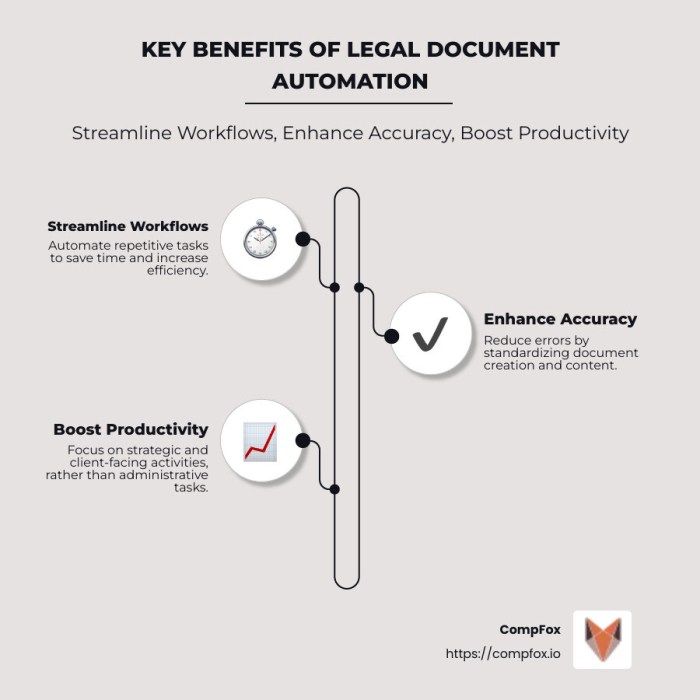
Technology has revolutionized the legal industry, leading to increased efficiency and productivity. By leveraging various technological tools and solutions, law firms and legal professionals are able to streamline their processes, improve accuracy, and deliver better services to their clients.
Key Technologies in Legal Document Automation
Legal document automation relies on a variety of key technologies to automate the creation, management, and dissemination of legal documents. Some of the essential technologies include:
- Document Assembly Software: Enables the creation of templates and automated document generation based on predefined rules and variables.
- Optical Character Recognition (OCR): Converts scanned documents into editable text, allowing for easier storage and retrieval of information.
- Artificial Intelligence (AI) and Machine Learning: Used for contract analysis, legal research, and document review to identify patterns, extract relevant information, and streamline decision-making processes.
- Cloud Computing: Facilitates secure storage, access, and collaboration on legal documents from anywhere, at any time.
Impact of Technology on Streamlining Legal Processes
The integration of technology in legal processes has had a significant impact on streamlining workflows and improving efficiency. By automating repetitive tasks, reducing manual errors, and enhancing collaboration among legal teams, technology has enabled legal professionals to focus more on strategic and value-added activities.
Additionally, the use of technology has led to faster document turnaround times, improved compliance with regulations, and enhanced client satisfaction through quicker and more accurate services.
Implementing Legal Document Automation
Implementing legal document automation systems can greatly improve efficiency and accuracy in legal processes. By streamlining document creation, review, and storage, law firms can save time and reduce errors. Below are some best practices and steps involved in setting up automated legal document workflows.
Best Practices for Implementing Legal Document Automation
- Identify key documents: Start by identifying the most commonly used legal documents in your practice.
- Choose the right software: Select a reputable legal document automation software that meets your firm's needs and integrates well with your existing systems.
- Train staff: Provide comprehensive training to staff members on how to use the new automation system effectively.
- Customize templates: Tailor document templates to match the specific requirements of your firm and clients.
- Regularly review and update: Continuously review and update automated templates to ensure accuracy and compliance with current laws and regulations.
Steps in Setting Up Automated Legal Document Workflows
- Assess current processes: Evaluate existing document creation procedures and identify areas that can benefit from automation.
- Choose a pilot project: Select a small-scale project to test the automation system before rolling it out firm-wide.
- Map out workflows: Create a detailed workflow map to visualize how documents will flow through the automated system.
- Implement and test: Integrate the automation software, test document creation and review processes, and make necessary adjustments.
- Train users: Provide hands-on training to staff members on using the new automated system efficiently.
Challenges and Considerations when Transitioning to Automated Legal Processes
- Resistance to change: Some staff members may be resistant to adopting new technology, so clear communication and training are crucial.
- Data security concerns: Ensure that the automation system complies with data protection regulations and implement proper security measures.
- Integration with existing systems: Ensure that the new automation software can seamlessly integrate with your firm's current IT infrastructure.
- Monitoring and maintenance: Regularly monitor the performance of the automation system and conduct maintenance to address any issues promptly.
Compliance and Security in Legal Automation
Ensuring compliance and security in legal automation processes is crucial for maintaining the integrity and confidentiality of sensitive legal information.
Importance of Compliance in Legal Automation
Compliance with regulatory requirements and industry standards is essential in automated legal document processes to avoid legal risks, penalties, or reputational damage. Implementing compliance measures helps uphold ethical standards and ensures the accuracy and validity of legal documents.
Security Measures for Protecting Legal Information
- Encryption: Utilizing encryption techniques to safeguard data transmission and storage, preventing unauthorized access to confidential legal information.
- Access Controls: Implementing strict access controls and user authentication mechanisms to regulate who can view, edit, or share legal documents.
- Regular Audits: Conducting regular security audits and assessments to identify vulnerabilities and address any potential security threats proactively.
- Data Backup and Recovery: Establishing robust data backup and recovery procedures to ensure the availability and integrity of legal information in case of data loss or system failures.
Methods for Ensuring Compliance and Security
- Compliance Training: Providing comprehensive training programs to educate employees on legal compliance requirements and security best practices.
- Compliance Monitoring: Implementing monitoring tools and software to track compliance with regulations and detect any deviations from established protocols.
- Security Policies: Developing and enforcing strict security policies and procedures to guide employees on handling legal information securely and responsibly.
- Third-Party Audits: Engaging third-party auditors to assess compliance and security measures independently, ensuring a thorough evaluation of the legal automation processes.
Future Trends in Legal Efficiency
In the rapidly evolving landscape of the legal industry, it is crucial to stay ahead of emerging technologies that are shaping the future of legal efficiency. With the increasing focus on streamlining processes and optimizing resources, the role of legal document automation is set to play a pivotal part in transforming the way legal professionals operate.
Artificial Intelligence Integration
As we look towards the future, one of the most significant trends in legal efficiency is the integration of artificial intelligence (AI) in legal document automation. AI-powered tools can analyze vast amounts of data, extract relevant information, and generate accurate legal documents with minimal human intervention.
This not only saves time but also reduces the margin for error, ultimately enhancing overall efficiency in legal workflows.
Blockchain Technology in Legal Documentation
Another emerging trend that is expected to revolutionize legal efficiency is the adoption of blockchain technology in legal documentation processes. Blockchain offers a secure and immutable way to store, authenticate, and transfer legal documents, ensuring transparency and minimizing the risk of fraud or tampering.
By leveraging blockchain technology, legal professionals can streamline document management and enhance data security in a decentralized manner.
Enhanced Data Analytics for Legal Insights
Looking ahead, advancements in data analytics tools tailored for the legal industry are poised to provide invaluable insights for legal professionals. By harnessing the power of data analytics, legal teams can gain deeper visibility into case outcomes, identify trends, and make informed decisions based on predictive analysis.
This data-driven approach not only enhances decision-making but also accelerates the resolution of legal matters, ultimately boosting overall efficiency in legal operations.
Conclusive Thoughts

In conclusion, Legal Document Automation and Legal Efficiency present a promising future for the legal industry, with emerging technologies shaping the landscape of legal processes. As automation continues to evolve, it will undoubtedly revolutionize the way legal documents are handled, emphasizing efficiency and compliance.
Stay tuned for the exciting developments ahead in the world of legal automation.
Query Resolution
What are the benefits of legal document automation?
Legal document automation enhances efficiency by reducing manual tasks, minimizing errors, and accelerating document processing.
What are the key technologies used in legal document automation?
Common technologies include AI-powered document generation tools, workflow automation software, and electronic signature platforms.
How can organizations ensure compliance in automated legal processes?
Organizations can ensure compliance by implementing thorough audit trails, regular monitoring, and integrating compliance checks within automated workflows.
What are some challenges when transitioning to automated legal processes?
Challenges may include resistance to change, data security concerns, and the need for thorough training on new automation systems.



![AI in B2B Sales: How It’s Used and Its Biggest Benefits [New Data]](https://digital.haijakarta.id/wp-content/uploads/2025/12/Sales-Automation-Tools-InsightSquared-Salesblink-120x86.jpg)